The Dreamer, The Builder
“He dreamed therefore we are…” reads the plaque that hangs in the offices of WVXU-FM.
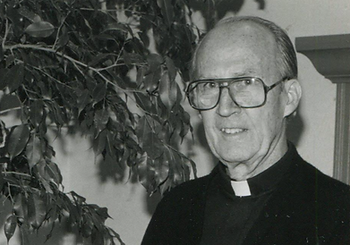
He is Rev. Lawrence J. Flynn, S.J., Ph.D., the original chairman of the department of Communication Arts at Xavier University. Fr. Flynn led the department for fourteen years, during which time he was instrumental in creating the university’s radio station and television studios.
The Jesuit priest, the plaque continues, “impacted countless lives as a teacher, an author, an historian. Fr. Flynn offered a living example of hard word, intense dedication, and, most importantly, love for others.”
“He was a very practical guy, but one who was always thinking about the future and thinking sometimes out of the box about solutions. How to grow things,” is how Jay Adrick, 1969 XU graduate remembers his friend.
On September 1, 1966 Xavier University President Rev. Paul O’Connor, S.J. upgraded Communication Arts from a minor to a major and named Fr. Lawrence Flynn to lead it. For the 52-year-old Jesuit priest with a doctorate in Speech, it was a return to his alma mater.
Lawrence Jerome Flynn was born and raised in Bellevue KY. His path to the priesthood and higher education was a checkered one, revealing a young man struggling with his future. After completing eighth grade at St. Anthony’s, he initially considered joining his father who owned a machine shop. Flynn attended the Ohio Mechanics Institute in Cincinnati for a year before attending Covington Latin and then St. Xavier High School.

In 1932 he enrolled and excelled at Xavier University, earning a Bachelor of Arts degree in English, History, and French in 1936. Flynn was one of only five in his class to be awarded a “Pro AlmaMatre Honor Key” in recognition of service in fields other than athletics. A classmate and close friend, Joe Link, would later play a significant role in Flynn’s life and in the university.
Still undecided on his future, the college grad attended law school at the University of Cincinnati for a year before deciding to pursue a religious vocation. He entered the Milford Novitiate of the Society of Jesus in 1937. While serving there as an instructor in Speech and English, Flynn continued his studies by taking summer classes at a variety of colleges, including the Detroit Institute of Musical Arts.
He was ordained into the Society of Jesus on June 14, 1949.
Flynn earned a Master of Arts in English from Loyola University in Chicago before four years of study at the University of Florida, earning a Ph.D. in Speech with a focus on Rhetoric, Radio, and Speech Education in 1955. He then returned to the Milford Novitiate for a decade of teaching.
The beginnings of communication study at Xavier actually had begun in 1962 when the Academic Council approved a course to be taught at the College Conservatory of Music's downtown campus.
Then-President Rev. Paul O’Connor, S.J. also formed a Communication Arts Committee to discuss approaches to broadcasting. Dr. Joseph Link, Jr., (that classmate of Fr. Flynn) served as chairman..
“It was agreed that the basement room in Alter Hall originally planned as a television center should be requested for the location of all broadcasting operations.”

Support the vision of Xavier President Rev. O'Connor and Fr. Flynn
W.I. McCord of RCA expressed interest and Clyde Haehnle of WLWT-TV estimated the cost for studio preparation and equipment — tape decks, microphones, television cameras, etc.. Dr. Link, then a professor of economics and business admiinistration at Xavier, secured a grant from the Walter E. Schott Family Foundation to establish "The Margaret Schott Link Radio Television Studios" as a gift to the students of Xavier University.
In the summer of 1966, University President O’Connor contacted Fr. Flynn. He knew that Fr. Flynn held a doctorate in speech education and had been teaching in Milford at the Novitiate. On September 1, 1966 O’Connor appointed Flynn the first chairman of Xavier’s newly approved Communication Arts Department.
Fr. Flynn worked tirelessly to build the department and develop a program that would prepare students for careers in broadcasting, journalism, and communication.

“You could tell he was bursting at the seams with a lot of ideas and plans,” remembers Jay Adrick, then an XU student. “He was willing to talk and listen and ask questions. Fr. Flynn brought in adjuncts like Paul Lunsford for various speech courses, Fr. Teppi to teach photography. Mr Maupin was already teaching speech and served as moderator of the campus radio station (WCXU). I had been the guy behind WCXU on the technical side. Fr Flynn was very helpful to me.”
Under Fr. Flynn's leadership, the department quickly advanced. In 1967, he played a crucial role in acquiring the former WCPO television studios on Symmes Street.
Media conglomerate Scripps Howard was building a new home for its CBS affiliate in Cincinnati. President Mort Watters offered Xavier the outdated television facility on Symmes Street, including its remaining equipment.
Rev. O’Connor, Rev. Flynn, and Dean of Students Rev. John Felton invited a student, Jay Adrick, to tour the facility and prepare a report on its potential use.

“I had the First Class FCC License and knew a little bit about television,” Jay remembered.
Adrick assessed the space and determined it could be restored to working order and converted into a teaching studio for Communication Arts students. Based partially on Jay Adrick’s report, Xavier University accepted WCPO’S offer.
“We had a $1 a year lease, paid the property tax on the site, and maintenance of the portion of the building we were in. We asked for tower rights to get a position on the CPO tower. My goal was to get the place operational.
“We replaced every resistor, and a lot of a capicators. We would have work parties with Xavier students and began offering classes in Symmes in January of 1968.”
This initiative provided students with hands-on experience in television production, laying the foundation for future careers in media. Fr. Flynn had recruited Bill Hagerty on the film side. And then Dave Gusherst and Ron Wilson on the TV side.
It was in the late 1960s when the university formalized a
"Charter of the On-Campus Radio Station WCXU-AM. The station shall have a definite chain of student command, managed and operated by students … as a training medium for qualified students interested in a broadcasting career."
The students were expected to take control, fully supported by Fr. Flynn.
Denny Moller, class of 1977, experienced that on the job. As station manager, “he gave me an early dose of how it felt to be responsible and how to lead. I'm pretty confident he saw me make mistakes and rather than correct me, let the consequences teach me the lesson.”
He was instrumental in transitioning Xavier's radio station from a closed-circuit system to an FM broadcast station. In 1970 WVXU-FM ("Voice of Xavier University") began over-the-air broadcasting. This move significantly expanded the station's reach and influence, offering students practical experience in radio broadcasting and serving the broader community.
In addition, Fr. Flynn taught a speech class.

“Tom, where are you from? he asked freshman Tom Stevens when they first met.
“Lou-a-vul,” which is the way people from Louisville pronounce it,” he replied.
Flynn: “I guess we have a little work to do on your diction. You mean ‘Louie-ville’, don’t you?”
Stevens: “So today when I tell people today where I’m from, I say Louie-ville. I know we say “Lou-a-vul,” but technically it’s Louie-ville.”
Larry Holt, class of 1973, can relate.
“I’m doing the news one day and said ‘… in Warshington.’
He met me in the hallway to ask ‘Larry, show me the R in that word.’
“From then on, if I said Washington while back home on the westside, my friends would say ‘My, aren’t we special!’
“I also had never heard the term ‘schwa.’ the most common vowel sound in the English language, until Fr. Flynn’s speech class.
Schwa. A vowel, represented in phonetic transcriptions by the symbol ə (upside-down e). Examples— the sound of the first and last a in America, the e in item, and the o in police and the sound between th and m in rhythm.
Larry and his classmate, Guy Hempel, still joke about the schwa.
Under Fr. Flynn’s leadership, the department quickly became a cornerstone of Xavier’s academic offerings, integrating practical training with a strong theoretical foundation.
Stevens was relieved when the department chairman took over the General Manager reigns in February of 1973.
“Fr. Flynn was like a breath of fresh air. Pretty much as soon as he took over, he let us start playing album rock in the late evening before signoff.”
The college newspaper reported on the university’s radio station in it’s March 1974 edition. “…91.7 on your FM dial is an educational non-commercial station owned by Xavier and staffed by 40 Xavier students under the direction of Fr. Lawrence Flynn. Aside from offering practical experience in broadcasting to any student with an interest in the field of radio and teleivision, it offers the Xaver campus some quality entertainment, along with naitonal, local, and campus news and interviews.”

But for WVXU, the game changer came in June 1976, when Xavier hired Dr. James King from the University of Cincinnati's College-Conservatory of Music faculty to be WVXU general manager and a XU faculty member. The station increased its power that year to 6,390 watts, but Fr. Flynn had a tough time convincing King to leave CCM.
"I was absolutely turned off by this pitiful little radio station with studios that barely worked," King tells me. "The equipment was ancient and mostly broken. The station had virtually no power, no format, virtually no direction, and little money.”
But Fr Flynn eventually won him over.

“1975-1976 was a very busy, very significant year of broadcasting on the Xavier campus. King promptly became the key person in the station… under contract as Associate Professor in Xavier's CA department, King was appointed General Manager of WVXU-FM, authorized to handle all radio station matters.”
– WVXU-FM, Evolution of a Public Radio Station
Fr. Flynn continued to serve as Chairman of the Communication Arts Department until 1980, when he reached the compulsory retirement age of 65. He resumed full-time teaching and remained actively involved with WVXU-FM. In 1981, he transitioned to a reduced teaching schedule, and began work on his book about the history of WVXU.

About the time that Fr. Flynn stepped down as department chair, Dr. King began a five-year transition to make WVXU professionally-run. He hired graduating students, like Mike Martini and George Zahn, but the move locked out opportunities for Xavier students.

When Xavier started acquiring properties around campus in the 1980s,
Fr. Flynn and Dr. King successfully lobbied to ensure WVXU could expand into a larger facility, along Herald Avenue.
In 1985, Fr. Flynn retired from full-time faculty status. A year later, he was named Professor Emeritus of Communication Arts and took on the role of Director of Public Information at WVXU-FM.
Flynn, the Builder
Fr. Flynn was a very practical guy, and not afraid to get his hands dirty.
“In the summer of ’73, the campus TV studio was racing toward completion before the fall semester,” recalled Marty Schadler, Class of 1974. “Jay Adrick recruited Mike Geis, Guy Hempel, Larry Holt, and me to help move the studio lights and other gear from Symmes Street and set everything up in Brockman Hall. And there was Fr. Flynn—our department chair—right there with us, climbing ladders, wiring up lights, running cables.”
Fr. Flynn’s roll-up-your-sleeves attitude came to the rescue again in the late ’70s, when WVXU was about to go stereo. To celebrate, the station planned a live broadcast of the Cincinnati Symphony from the Kenwood Mall. Xavier had purchased a new transmitter—only to discover it was tuned to the wrong frequency.
“We couldn’t wait for a replacement,” recounted Adrick, “so the company faxed over the drawings and we sourced the raw materials ourselves. The parts had to be milled and turned on a lathe. That’s when Fr. Flynn stepped in. He threw on his jeans and a shop apron, machined the pieces, silver-plated them in the chemistry lab, and we rebuilt the transmitter. Fr. Flynn made it all happen.”
“After the radio station moved into its new building,” recalled then student Mike Martini, “Doc (King) gave Father a corner office as well as a large workshop in the back of the building, where Father kept his tools and stuff. He wanted to be “useful” so he would build things, like this elaborate “box elevator” that he made out of wood, pulleys and rope.”
And then there was the summer Fr. Flynn added “homebuilder” to his résumé.
Jay Adrick had designed a second-story addition for his house and planned to build it himself—with help. Fr. Flynn, Schadler, and Mike Geis made up the construction crew.
“There was Fr. Flynn back in jeans and a t-shirt right in there with us,” noted Jay. “We had the addition framed and roofed within a week. Fr. Flynn fabricated the duct work. He was that kind of guy. He really enjoyed building things with his hands.”
Rev. Lawrence Jerome Flynn, S.J. passed away July 27, 1990.

To honor his contributions to Xavier University and its media programs, Xavier University named Flynn Hall after him in 1991. Additionally, the Rev. Lawrence J. Flynn, S.J., Memorial Scholarship was established through a bequest from his sister, Anna Flynn, to support students in the Communication Arts program.
In the early 2000s, a religious group approached King with a $15 million offer to buy Xavier’s radio station. Although he personally opposed the sale of the station, King was obligated to take its offer to the board of directors. Needing funds to develop the campus, Xavier University eventually agreed to sell WVXU and the affiliated X-Star Network in March 2005 for $15 million to Cincinnati Public Radio.

The Communication Arts department survived as the Communications Department. The television program became Electronic Media, and today thrives as the Digital Innovation, Film and Television (DIFT) program.
“We all here at WVXU owe an awful lot to him. We owe this radio station to him,’ said George Zahn, one-time operations manager of the public radio station. “It was really his vision.”


Comments